How Skill Is Built
A Free Course For Coaches
How The Best Coaches In The World Are Training Now
Coaches Running CLA
600+
Have set up a gym to coach this way, on five continents.
- 400+Americas
- 100+Europe
- 40+Oceania
- 30+Asia
- 4Africa
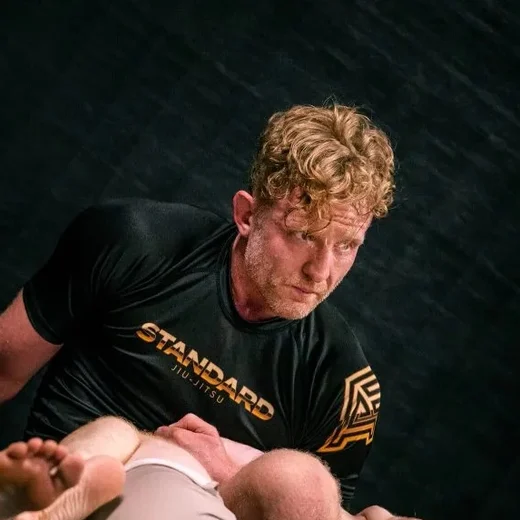
The curriculum is built with Greg Souders of Standard Jiu-Jitsu, who coaches Team Americas at CJI 2. His student Gavin Corbe took second at the 2026 ADCC World Championship on under two weeks’ notice, and Gavin’s brother Deandre took first at the ADCC West Coast Trials.
What You Are In For
- Nine levels. A minute or two each, and they build in order.
- One question at the end of each one. Get it right and the next level opens. A wrong answer is never a buzzer, it is an explanation.
- Your place is saved. Close the tab whenever you want and pick it up where you left off. No sign up, nothing leaves your browser.
This is for coaches who want to understand how people actually move and learn. You do not have to agree with any of it. Either way you finish better informed than you started.
Level 1 of 9
Let's Start With A Question
Can you explain why somebody drills a move perfectly, step by step, for a month, and then cannot hit it once live?
Answers that do not count
- They need more reps
- They need more time
- They need to do it live more
- They are not going hard enough
- Some people just have it
Every one of those either restates the problem or says what to do without saying why. By the end of this you will be able to say why, in a sentence.
We will start with the traditional approach and the constraints-led one, and what each assumes about how somebody gets good. Once both are on the table we can look at which of those assumptions holds up, and at the end we come back to the question above.
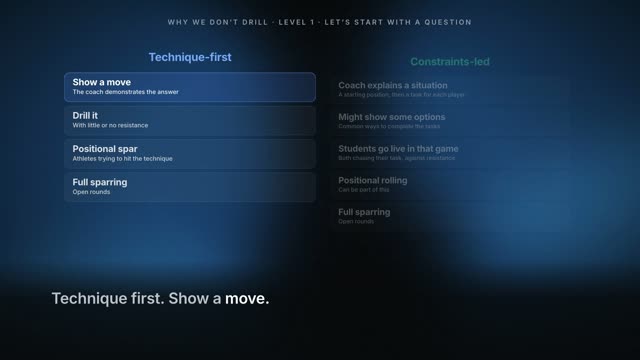
The Traditional Approach
- Show A MoveThe coach demonstrates the answer
- Drill ItWith little or no resistance
- Positional RoundsFrom the position, athletes trying to hit the technique
- Full RoundsOpen rolling
Constraints-Led Approach (CLA)
- Coach Explains A SituationA starting position, then a task for each player
- Might Show Some Ways To Do ItCommon ways to complete the tasks
- Students Go Live In That GameBoth chasing their task, against resistance
- Positional RoundsCan be part of this
- Full RoundsOpen rolling
Both end in full rounds, and both can use positional rounds. There is exactly one step the traditional approach has that the other does not: the drill, with the resistance taken out. That one step is the whole disagreement.
None of this started in jiu jitsu. It comes out of decades of motor learning research. It reached grappling late.
Next, the case for drilling, put as well as it can be put.
Level 2 of 9
The Case For Drilling
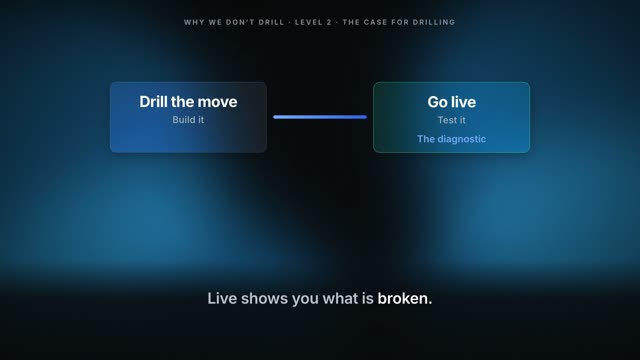
Here is the crux. One side says you need reps with the resistance taken out. The other side says you do not. Everything else on this page comes off that.
Most coaches on the first side are not rejecting games. They think games plus drilling beats games on their own. So before arguing with that, here is the case for it, put as well as it can be put.
The Model Underneath It
A loop between drilling and live. Live shows you what is broken. You go back and drill the fix, then test it again.
Find the gap, drill the fix, test again
Live is the diagnostic. Drilling is where the fixing happens.
Which Means Drilling Is Doing Two Jobs
- Transmission. You have the answer, they don't. The demo is how it gets across. Without it they don't know what to attempt.
- Storage. Enough reps and the movement pattern is stored in their body, so it's there in a roll without thinking.
Both are worth taking seriously, so next we take a closer look at each one. Storage first.
Next, what exactly would be getting stored.
Level 3 of 9
What Exactly Is Being Stored?
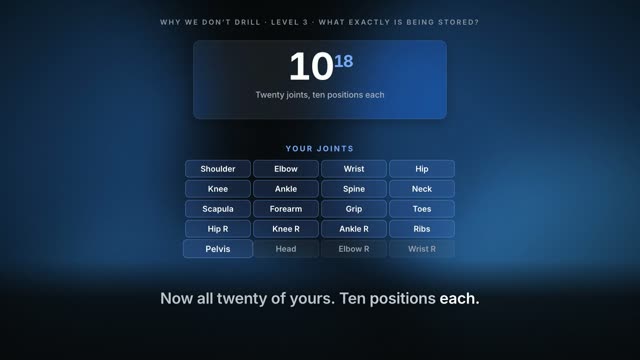
Where Would It Even Live?
In your brain? Your muscles? Is it the joint angles? Or a range of them?
And now add him
There is nowhere to keep that many movement patterns. Not in a brain, not in a body. So something else must be going on when you move.
Rough numbers: 20 joints, 10 positions each.
Next, if nothing is stored, how do you move at all?
Level 4 of 9
So How Do You Move at All?
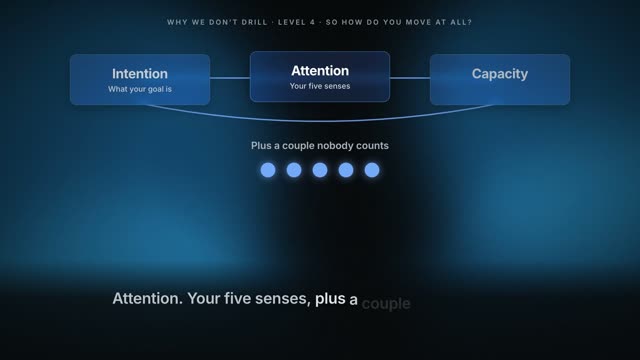
So if it isn't a database, what is it?
Researchers say you build the movement on the spot. Nothing gets retrieved. What comes out is a relationship between three things.
- IntentionWhat your goal is. Big ones have smaller ones inside them. Win the match, and inside that, pick up his leg.
- AttentionYour five senses, plus a couple nobody counts. Balance, and knowing where your own limbs are.
- CapacityWhat your body can actually do. Strong enough, bendy enough, coordinated enough.
Which is why no two movements are ever identical.
Sign your name twice and look at them. If you were replaying something stored, they would match. Even in a drill you were building it fresh every single time.
Next, how anyone gets better at it.
Level 5 of 9
So How Does Anyone Get Better?
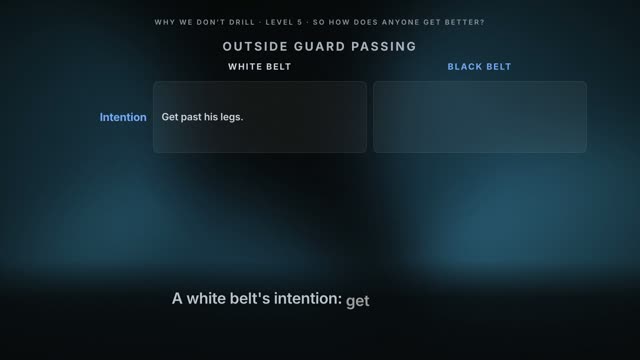
So what do the reps do? They sharpen all three. What they never do is add a move, because there is nowhere to put one.
What the old model thought drilling did
Reps store a movement pattern in your brain. Later you run it.
What new research says drilling does
Nothing is stored. It gets built on the spot, every time, out of intention, attention and capacity.
That sharpening has a name. Attunement. You try something, the situation tells you whether it worked, and over enough of that all three have moved.
Outside guard passing
Next, drilling and live side by side, on all three.
Level 6 of 9
So Why Is Going Live Better?
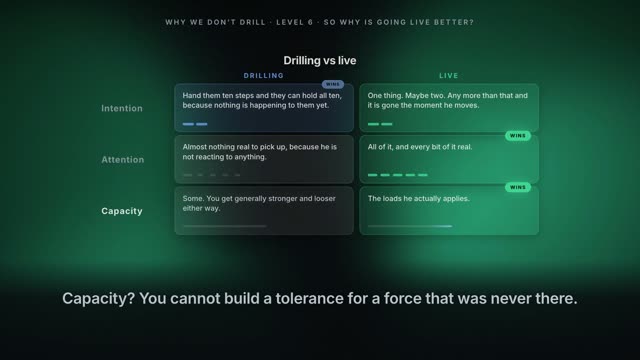
Drilling does sharpen all three. Nobody is claiming it does nothing. Now that we are using the same words, the argument gets narrower. It was never that drilling fails. It is that it is less efficient. You could spend that time much better elsewhere.
Drilling vs live
So drilling does genuinely make it easier to prime someone’s intention. But you pay for it twice. You give up the real information coming off a live opponent. And you can overfit to things that only work when nobody is stopping you.
How many moving parts are in the environment?
Grappling sits near the far end of that scale. Take the resistance out and you take most of that information with it. Both the theory and the early experiments point here.
Next, the hard cases. Starting with heel hooks.
Level 7 of 9
The Hard Cases
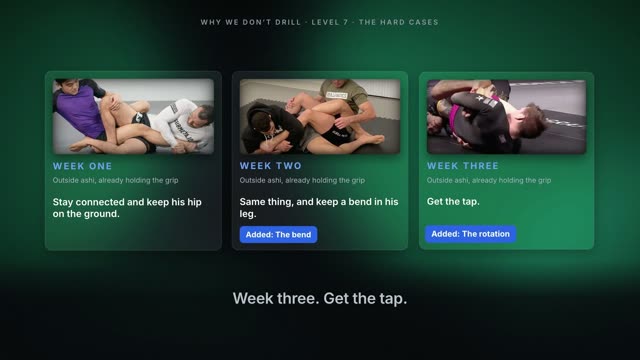
Say every session is live. So how does anyone learn anything without being shown exactly what to do?
Take heel hooks, the one everybody names as impossible to learn live.
A general rule to follow is this. If they can't achieve the goal immediately, it's too complex to begin with.
So start them somewhere they can already cope, and add one layer a week.
Every layer is live. The smaller tasks are optional, added for one person when you think they are ready, not for the whole room.
The Other Two Dials
The weeks above change what they have to do. Two more things are yours to turn, and for a beginner you turn these first.
Where they start
What his partner is allowed to chase
Three dials, not one. Turn the position and the partner down first, then add what they have to do inside it.
Now look at what you actually did there. Every one of those weekly goals is an intention, and you primed it the same way a technique class does. You said the words, he held the idea.
You just gave him one instead of six, and you scaled it so he could do it live, while somebody was trying to stop him. That is the answer to the question this level opened with. You never stopped telling him things.
The job was never whether to prime an intention. It is how big a one he can carry live.
Six details to a room, before anyone is stuck, is not more coaching. It is a dose nobody in the room can hold once the other guy stops cooperating.
Next, back to the two ideas we started with.
Level 8 of 9
The Two Assumptions
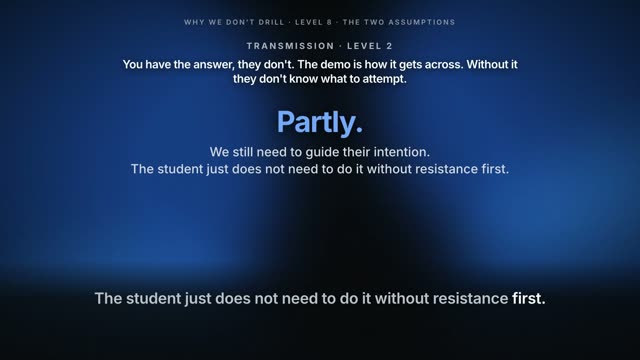
By now we have a picture of what is going on, and a way to start building games. So let’s circle back to the two ideas we started with, about how drilling builds skill.
Word for word from level two. One does not survive at all. The other is real, and much smaller than it looks.
- Transmission
You have the answer, they don't. The demo is how it gets across. Without it they don't know what to attempt.
Partly. We still need to guide their intention. The student just does not need to do it without resistance first. Scale it so they can achieve the task at a rate that fits them. - Storage
Enough reps and the movement pattern is stored in their body, so it's there in a roll without thinking.
Gone. There is nothing for it to be in, and the numbers were never survivable anyway. Every movement gets built on the spot, out of intention, attention and capacity. That is why no two of your own reps are ever identical.
Next, the complaints, including the ones that land.
Level 9 of 9
Common Complaints
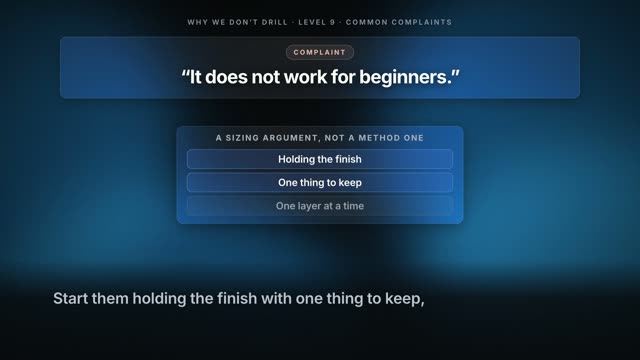
Coaches Already Running It
What It Changed In Their Room
“It’s helped me to reduce the time it takes to design practices for my gym significantly… They’re able to go back, review and actually remember the specific skills we were focusing on during each practice. Overall, it’s just made my coaching process more efficient and my athletes more engaged.”
Ryan MoutinhoHead Coach and Owner, Connecticut Submission Grappling

“It’s flexible and modular, you can fit it into the coaching style you’re currently using, so you don’t have to subscribe to any kind of coaching style… You can schedule a yearly class plan just through five or seven clicks. My verdict is a big would-recommend.”
Nikola MilicJiu-Jitsu Coach, Croatia
More Coaches

Click any one.
The Question We Opened With
Can you explain why somebody drills a move perfectly, step by step, for a month, and then cannot hit it once live?
Back to the question at the top
He attuned perfectly. Just not to anything that is in the match.
For a month he got better at reading a partner who had already agreed what to do. He also got better at chasing goals about his own body parts. Both of those sharpen. Neither one is there when somebody is trying to stop him. Nothing was wrong with the reps.
Get Your First Month Of Classes Built, Free
Pick a time that works for your gym.